

SASCOM Seminar Series - From CT Reconstruction to Fracture Prediction: High-Fidelity Characterization and Numerical Simulation of Material Microstructures
Monday, November 30th, 2026.
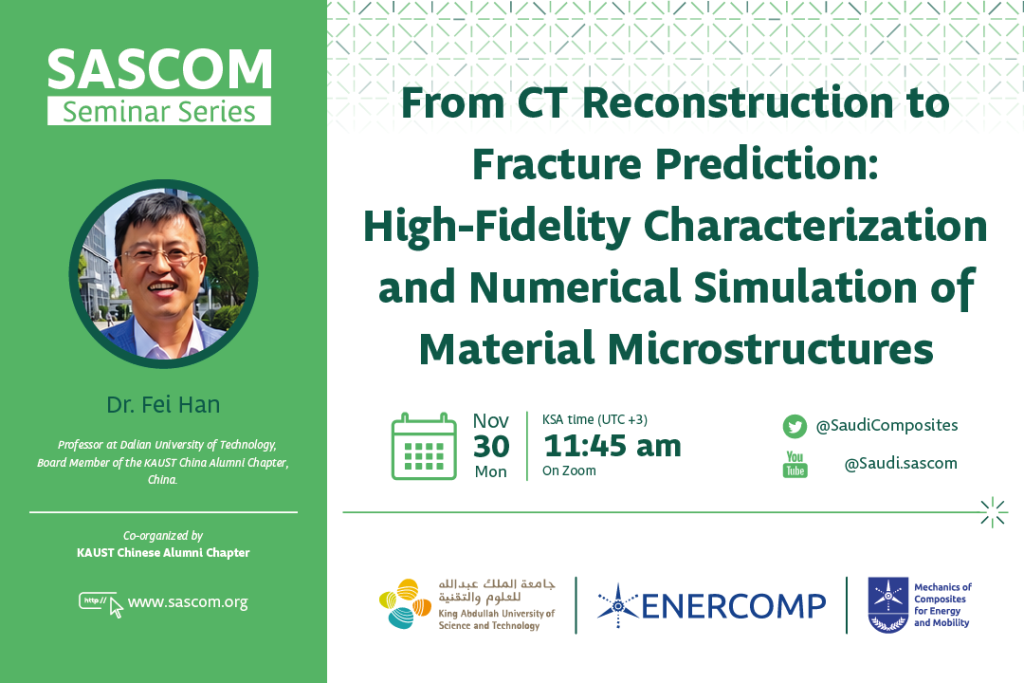
This seminar is co-organized by the KAUST China Alumni Chapter.
ABSTRACT
Addressing the limitations of traditional numerical simulations—which rely on idealized geometric models and fail to capture real manufacturing defects—this presentation proposes a full-chain, high-fidelity simulation paradigm driven by real X-ray CT data and artificial intelligence (AI). Focusing on additively manufactured (AM) BCC lattice structures and C/SiC ceramic matrix composites as core case studies, the report systematically demonstrates technical breakthroughs in two key dimensions: rapid characterization/reconstruction and complex fracture prediction.
- Rapid Reconstruction and High-Fidelity Finite Element Analysis via Deep Learning and Dual-Exposure μ-CT: To address the time-consuming nature of high-precision μ-CT scans (60 mins) and the extreme complexity of mesh generation, a strategy combining “paired long/short-exposure scanning with U-Net deep learning segmentation” is proposed. This method significantly reduces the scanning time to 7.5 minutes per sample and automatically generates high-quality labels. In the AM Ti-6Al-4V BCC lattice case, the U-Net reconstructed model accurately captures the true thickness distribution and pore characteristics. Furthermore, its simulated mechanical response under in-situ compression (force-displacement curve) significantly outperforms the idealized CAD model and aligns closely with the experimental data.
- CT Data-driven Peridynamic (PD) Fracture Simulation: To overcome mesh distortion and convergence issues encountered by finite element methods during complex microcrack propagation in composites, an innovative approach is introduced that bypasses macroscopic geometric reconstruction and directly constructs a PD model using CT voxel/pixel data. Using own AI-assisted defect recognition software, the method accurately assigns material attributes (fiber, matrix, and pore) to C/SiC composites. This approach successfully predicts the initiation, propagation, and final fracture morphology of internal microcracks, while quantitatively revealing the influence of porosity on fracture modes.
This presentation establishes a digital material R&D framework: “Real CT Data Acquisition -> AI Intelligent Segmentation -> High-Fidelity PD Computation.” This framework resolves the trade-off between the precision and efficiency of μ-CT, bridging the gap from “morphological characterization” to “mechanical response prediction.” It provides core technical chain support for the efficient R&D and engineering service evaluation of advanced materials.
About the Speaker
Fei Han, Ph.D., is a professor at Dalian University of Technology and a Board Member of the KAUST China Alumni Chapter. His research focuses on multiscale modeling of materials and computational methods in mechanics, with a particular emphasis on peridynamic theory, an area of growing international research interest. His original contributions to peridynamics have drawn broad attention from researchers around the world. He has been invited to contribute two book chapters, has published more than 60 academic papers, and has translated three scholarly books.
Dr. Han founded Hangzhou ChenYu PeriTech Co., Ltd., which focuses on developing industrial computer-aided engineering (CAE) software and commercializing related technologies. He also co-founded Hangzhou Zhonglian Intelligent Detection Technology Co., Ltd., whose core services include X-ray CT inspection, image processing and data extraction, and software development. The company specializes in advanced 4D X-ray CT testing with in situ loading at high and low temperatures, including ultra-high and ultra-low temperatures.
Dr. Han received his Ph.D. in applied mathematics from Northwestern Polytechnical University in 2010. In August 2010, he began postdoctoral research with Professor Gilles Lubineau at King Abdullah University of Science and Technology (KAUST), where he was promoted to research scientist in January 2015. He has held his professorship at Dalian University of Technology since December 2017.
By Prof. Fei Han
Professor at Dalian University of Technology and a Board Member of the KAUST China Alumni Chapter
- 00Days
- 00Hours
- 00Minutes
- 00Seconds

Legal
KAUST Campus, 23955-6900 Thuwal, Saudi Arabia
email: contact@sascom.com
Copyright © 2020 SASCOM | Composites Lab | All rights reserved